


What Is the 135 Rule in Plumbing and Why It Matters
Slow drains are one of the most common plumbing complaints among homeowners, and one of the most misunderstood. In most cases, the problem isn’t what’s going down the drain. It’s the angle of the pipe itself.
The 135 rule in plumbing is the building code standard that governs how sharply drain pipes can turn, and when it’s violated, no amount of drain cleaner will keep your drains running clean for long.
This article explains what the 135 rule is, why improper pipe angles cause recurring clogs, and what homeowners should know before calling a plumber about a slow drain.
The Drain That Just Wouldn’t Stay Clear
It had been happening for months. The kitchen sink drained slowly, not completely blocked, just sluggish. A bottle of store-bought drain cleaner would fix it for a few weeks, then the problem would creep back. The bathroom tub was next. Then the laundry room floor drain started backing up after every wash cycle.
For many homeowners, slow drains feel like a fact of life, annoying but manageable. But the root cause is rarely grease or hair. It’s something built into the walls of your home long before you ever moved in: the angle of your drain pipes.
That’s where the 135 rule in plumbing comes in, and understanding it could save you from calling a plumber every few months for the exact same problem.
What Is the 135 Rule in Plumbing?
The 135 rule refers to the maximum angle allowed when drain pipes change direction. Specifically, it states that no single change in pipe direction should exceed 135 degrees, which translates to a maximum 45-degree turn from the pipe’s straight path.
Here’s the plain-language version: water and waste need to flow downhill through your pipes by gravity. When those pipes turn too sharply, at 90 degrees, for example, the waste slows down dramatically.
Debris catches on the bend. Over time, that buildup narrows the pipe, restricts flow, and eventually causes the slow drain or full blockage you’ve been fighting.
A 90-degree bend in a drain line isn’t just a sharp turn, it’s a debris trap waiting to form a clog.
Service Squad Plumber Expert.
| Pipe angle | Drain performance |
|---|---|
| 90° bend | High clog risk, waste stalls at the turn |
| 135° bend | Code-compliant, smooth flow maintained |
| 45° bend | Ideal, minimal resistance |
Why Improper Pipe Angles Cause Recurring Clogs?
Most homeowners assume a clog is caused by what goes down the drain, grease, hair, soap scum. And yes, those things contribute. But when a clog keeps coming back in the same spot, the pipe angle is almost always the deeper issue.
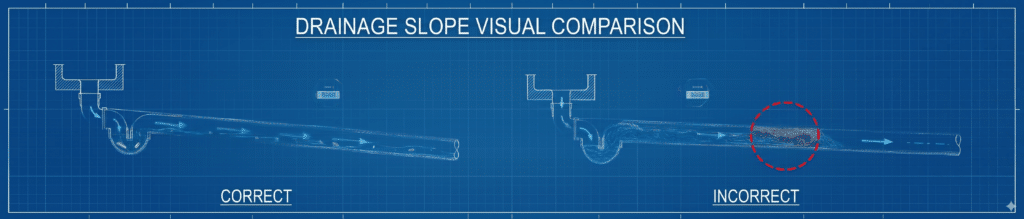
Here’s what happens inside a drain with too sharp a bend:
- Waste velocity drops sharply at the turn. Gravity-driven flow depends on a smooth, consistent path. A 90-degree elbow creates turbulence and dramatically slows the waste stream.
- Solids separate from the water. When flow slows, heavier particles drop out of suspension and settle at the bend, exactly where the pipe is hardest to clean.
- Partial clogs trap more debris. Once a partial blockage forms, every subsequent use makes it worse. What started as a slow drain becomes a full backup over months or years.
- Drain cleaners only offer temporary relief. Chemical cleaners dissolve organic buildup but can’t fix the underlying angle. The clog returns because the cause was never addressed.
In Fort Worth homes, many of which were built in the 1970s and 80s, before modern plumbing codes became standard, improper pipe angles are surprisingly common. If your home has older galvanized or cast-iron drain lines, the odds increase further.
How to Know If Your Home Has a Pipe Angle Problem
You won’t see your drain pipes without cutting into walls, but your drains will tell you if something’s wrong. Watch for these signs:
- The same drain clogs repeatedly, even after professional cleaning
- Multiple drains in the home run slowly at the same time
- You hear gurgling sounds after water drains, air being pulled through a partial blockage
- Drain cleaner works briefly, then the problem returns within weeks
- Your home was built before 1990 and has never had a plumbing inspection
If two or more of these apply to your home, a camera inspection is the fastest way to get a definitive answer. A Plumber can run a small camera through your drain lines and show you exactly where the problem is, and whether it’s a buildup issue or a structural pipe angle issue that requires a fix.
What the Fix Looks Like
| Fix Type | What It Involves | Best For |
|---|---|---|
| Drain Cleaning (short-term relief) | Professional hydrojetting or snaking removes organic buildup, grease, hair, soap. Restores flow quickly but does not fix an underlying pipe angle problem. | Organic blockages with no structural pipe issue |
| Pipe Reconfiguration (long-term solution) | Replaces a code-violating 90° elbow with two 45° elbows or a long-sweep fitting. Cost rises significantly if the line is inside a wall or under a slab. | Single problem bend on an accessible line |
| Full Drain Line Replacement (major repair) | Section-by-section replacement of improperly angled lines, often upgrading from galvanized or cast iron to modern PVC. Most cost-effective for older homes with multiple problem sections. | Homes built before 1990 with widespread pipe angle issues |
Think Your Slow Drain Might Be More Than Just a Clog?
Service Squad Plumbing offers camera inspections and drain cleaning for Fort Worth homeowners. We’ll show you exactly what’s going on inside your pipes, and give you an upfront price before any work starts. Book a Free Estimate
Same-day appointments when available · Transparent pricing · Licensed Fort Worth plumbers
Or Stop Paying for the Same Drain Twice
Most recurring drain problems are preventable with regular maintenance. The Service Squad Membership gives Fort Worth homeowners an annual plumbing check, front-of-the-line priority service, and discounted diagnostics, all for $9.95 a month.
Less than a coffee. Less than one repeat service call. See what’s included in our membership.
FAQ
What is the 135 rule in plumbing?
The 135 rule states that drain pipes cannot change direction by more than 135 degrees, a maximum 45-degree turn, in a single fitting. It exists to keep waste flowing smoothly by gravity. Tighter bends slow the flow, trap debris, and cause recurring clogs.
What is the minimum fall for a 4-inch sewer pipe?
Texas plumbing code requires a minimum slope of ¼ inch per foot on a 4-inch drain line. This keeps gravity pulling waste through consistently. Too flat and solids stall; too steep and water outruns debris, both result in buildup and blockages over time.
What is the angle between drains and inspection manholes, 45, 90, 135, or 180?
135 degrees is the standard for horizontal drain lines, that’s the 135 rule in practice. A 90-degree bend is only acceptable in specific vertical transitions using a long-sweep fitting. On horizontal runs, anything tighter restricts flow and violates Texas plumbing code.